It might seem redundant to post about waxboil here given that there’s been extensive discussion about it on Deskthority. But if this topic can help a couple of people get the gist of the method without having to wade through the, ahem, interesting vibe and creative namecalling in the Deskthority thread, then I think it’s worth it.
For context, I’ve tried a few techniques for achieving smooth Alps including:
- Just disassembling and dusting out the switches
- Lubing with silicone grease (one of the lubes recommended by Chyrosran22 in this video).
- Buying new old stock.
So I have a couple of points of comparison for the wax method, which is helpful.
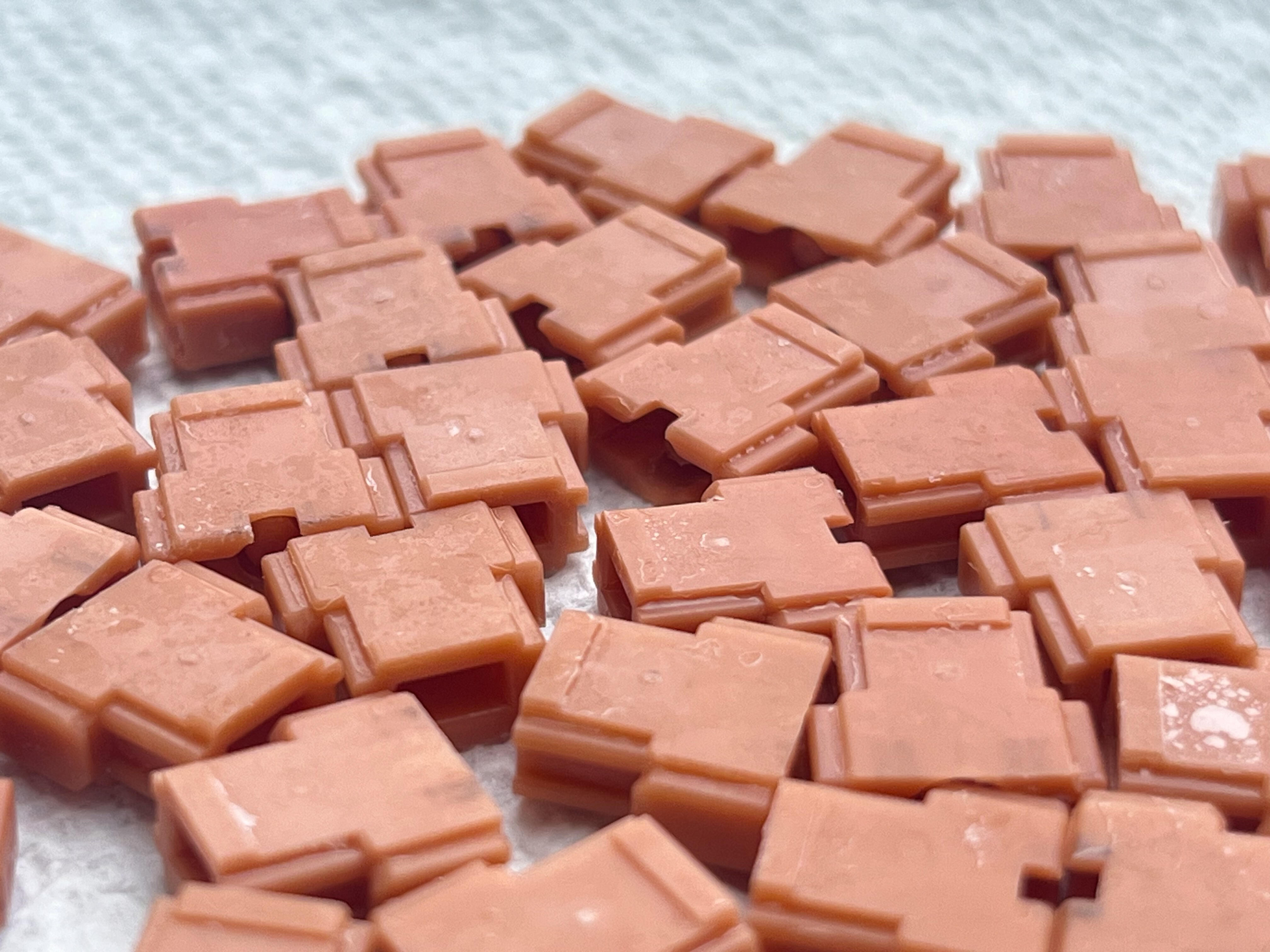
Orange Alps sliders with a newly applied coat of wax
Step-by-step guide
The idea is to coat your switch sliders with a thin film of paraffin wax. As others have pointed out, paraffin is chemically-speaking nothing like the original Alps factory lubrication, but hey, a number of hobbyists swear that practically speaking it feels and sounds close, so why not try it.
There are two Deskthority users who have put out video tutorial of the approach they use (soyuz’ video here; Jezzuz’s video here). I’m going to treat their videos, which are very similar, as the “standard approach”… in any case, it’s the approach I tried. I also wanted to try the slightly different steps documented over at wiki.keyboard.institute but unfortunately the wiki seems to be broken so I can no longer access those docs. I’m not sure but it seems that soyuz also runs/ran the Keyboard Institute website and goes by the name Kuritakey as well? Hopefully I’m not confusing people.
Anyway, here are the steps:
- SOURCE WAX: Most tea light candles are made with paraffin wax with no added dyes or coating, so that’s an oft-recommended easy source. Candle sticks are NOT recommended.
- CLEAN SWITCHES: Thoroughly clean the top housings and sliders of your switches ahead of time (warm water and soap + multiple rinses, or ultrasonic cleaner, or boiling, etc.). Before using boiling water on anything, make sure your switches are an early “pine” type, and not the later “bamboo” type. Bamboo”switch housings may not withstand boiling temperatures.
- APPLY LUBRICANT: Put the clean switch sliders in a bowl and add a small amount of paraffin wax shavings. For 100 switches I used about a teaspoon’s worth of shavings. Add hot water to the bowl (but obviously take precautions to not crack it if it’s made out of glass). This will cause the wax to melt and mostly float on top of the water, while the switch sliders will sit on the bottom. You have to stir vigorously for a minute or so (or use a sealed jar instead of a bowl and shake) to get the wax to actually collide with the switch slider and adhere to them (Thomas famously skipped this step in his video on the subject).
- DRY: Pour the contents of your bowl into a strainer to strain out the water and loose wax. Spread the sliders out on a soft surface (e.g., paper towel) where they can dry with minimal disruption to the still soft wax coating. This is a good time to do a visual inspection of the sliders and verify that there is a wax film deposit, and that it is roughly even, especially on those parts of the slider that are in contact with the top housing, the contact leaf, and the tactile/click leaf.
- BREAK IN: After the top housings and the sliders are dry, reassemble the switch. They may feel and sound disappointing at first, but this may be because they need to be broken in.
- They may feel disappointingly rough because the surface of the wax film isn’t perfectly smooth. But over the span of the first few hundred key presses, the feel often improves as friction against the wax evens it out.
- With tactile switches, you might get a click on the upstroke that wasn’t there before. Soyuz noted in their video that this means the wax film is too thick and you need to re-open the switch and scratch some of it off. Similarly, Jezzuz recommends systematically wiping off the wax on the part of the slider that comes into contact with the tactile/click leaf ahead of time. But, in my experience, neither measure is really necessary; just actuate the switch very rapidly for 15 seconds or so and the excess wax will rub off on its own, causing the click to go away. If the click doesn’t go away, then the switch may just need a paper mod, regardless of wax.
My experience
Disclaimer: So far I’ve only tried this mod once with Orange Alps. I may do it again with some Blue Alps. If I do, I’ll edit this post to account for any new information.
My verdict: this method definitely improves the switch feel by a large margin, but it’s not effective enough to get them to feel new or near-new. Worth it? Especially for a quicker method? Absolutely. Magic? Unless I’m not doing it right: not really.
How does it compare the other methods I’ve tried?
- NOS is still head and shoulders above wax. Unless, perhaps, your switches are in good condition to begin with, which wasn’t my case.
- Thorough dusting: the wax is more effective that just dusting out the switches, but I can’t personally speak to whether or not the wax feels better than a more in-depth ultrasonic cleaning, for example. Soyuz says that the wax mod drastically improves previously ultrasonic-ed switches that still bind.
- Silicone grease: ignoring the fact that there are of course a lot of variables here, in my experience the grease is a bit more effective than the wax at producing smoothness…
- …but the grease also alters the feel and sound of the switch more than the wax. The wax doesn’t feel slick and wet the way the grease does. Of course, some people like the wet feel and sound of lube, so not necessarily always a negative.
- Applying the silicone grease one slider at a time is a much more tedious process than applying the wax in a batch.
- Finally, although this is just pure speculation, I wouldn’t be surprised if the silicone grease lasts longer. It’s worth noting that users on Deskthority have reported that their wax mod still feels great about a year later.
So it’s not a slam dunk; for anyone wanting to restore their switches I’d say this is just one option among others.
In my opinion, doing a wax boil restoration makes sense if 1) the switches are bad enough that you need to do more than just a cleaning, but 2) at the same time you don’t want to lube with grease either because it takes much more time than a wax boil or because you don’t like the idea of altering the switch feel too much.