Whistles in Darude Sandstorm
4 Likes
This is one of the reasons why I have so many solder PCBs not soldered - not just for changing switches, but plate and other things because I also feel like I have to type on something for a while before I realize it’s not quite right…that’s the fun of it though too, I know haha
Also this board looks so good!
2 Likes
I’ve been getting terrible key-bounce and sticking keys so decided time
to clean the keyboard I’d already cleaned a set of Gateron Baby Kangaroos to replace the
installed Akko Matcha Green switches
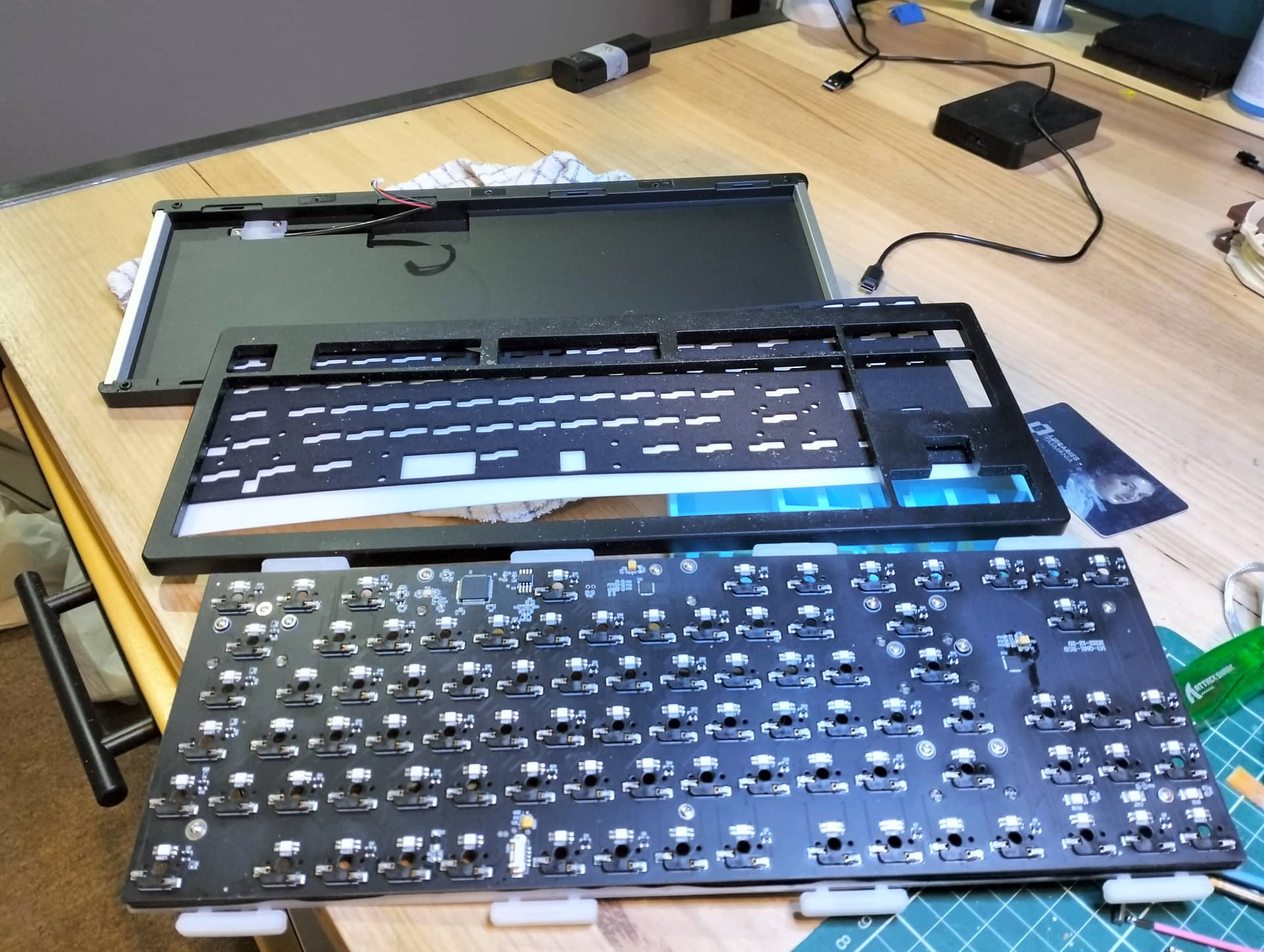
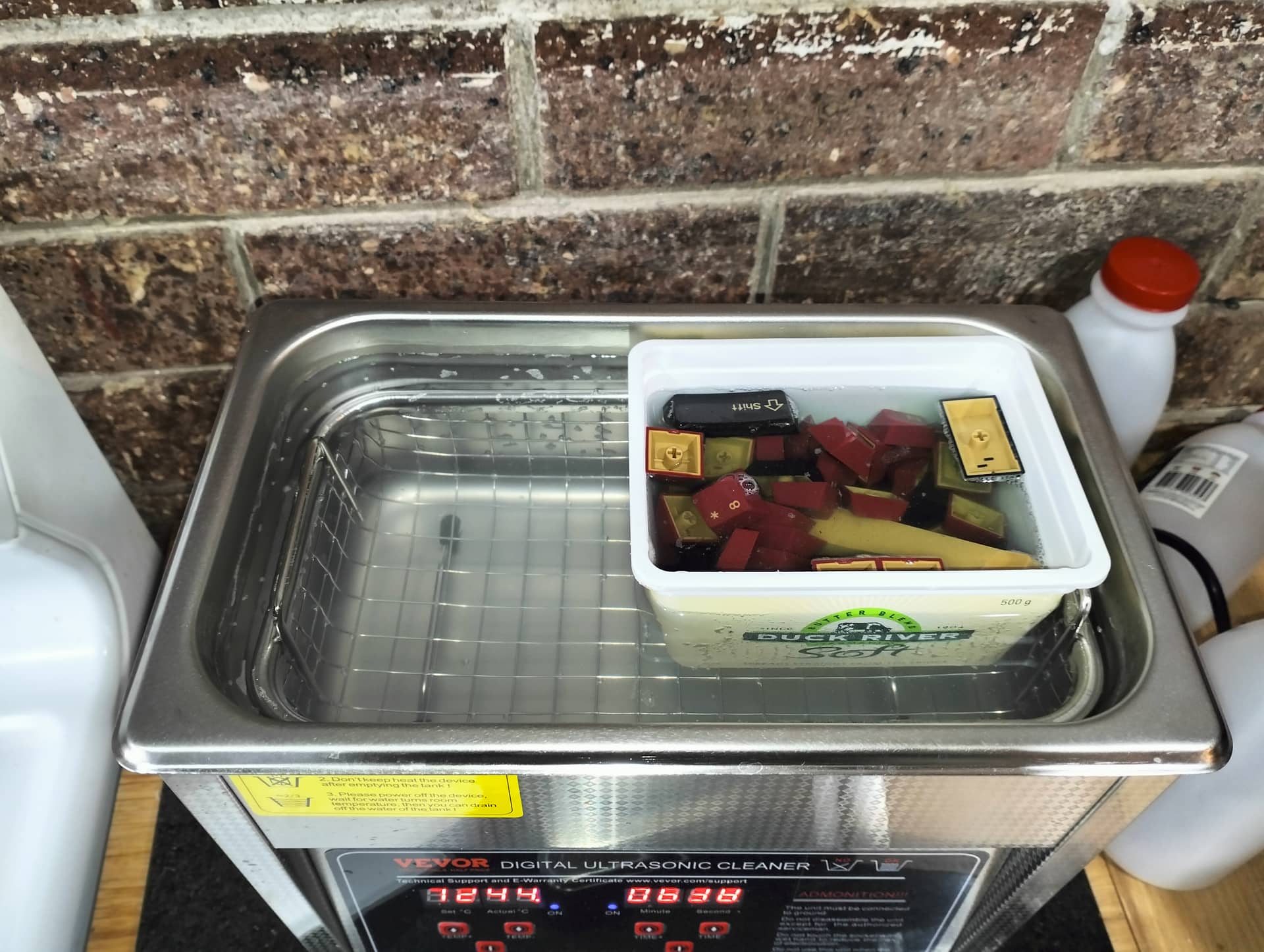
Removed the keycapss and switches without to much drama, dropped the
keycaps in the ultrasonc cleaner for 10 minutes is a solution of
simple green, not too harsh.
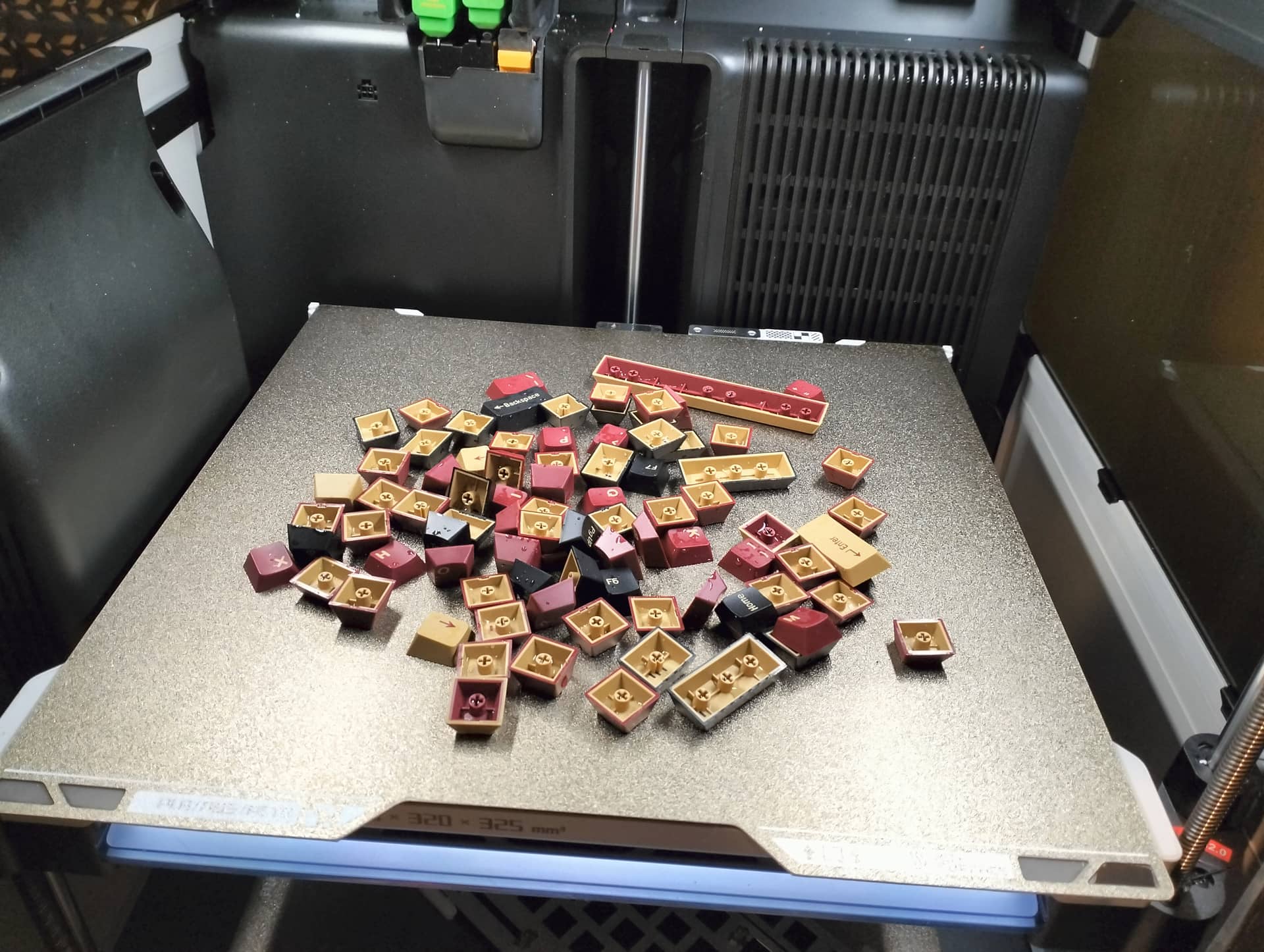
To dry the keycaps, I put them on the bed
of the 3d printer and turned up the chamber temperature to 60c for
about 25 minutes. Also ran the Akko switched though the ultrasonic in
some IPA (no, not THAT IPA, isopropyl alcohol) - for next time.
A good clean of the PCB with IPA and re-assembled
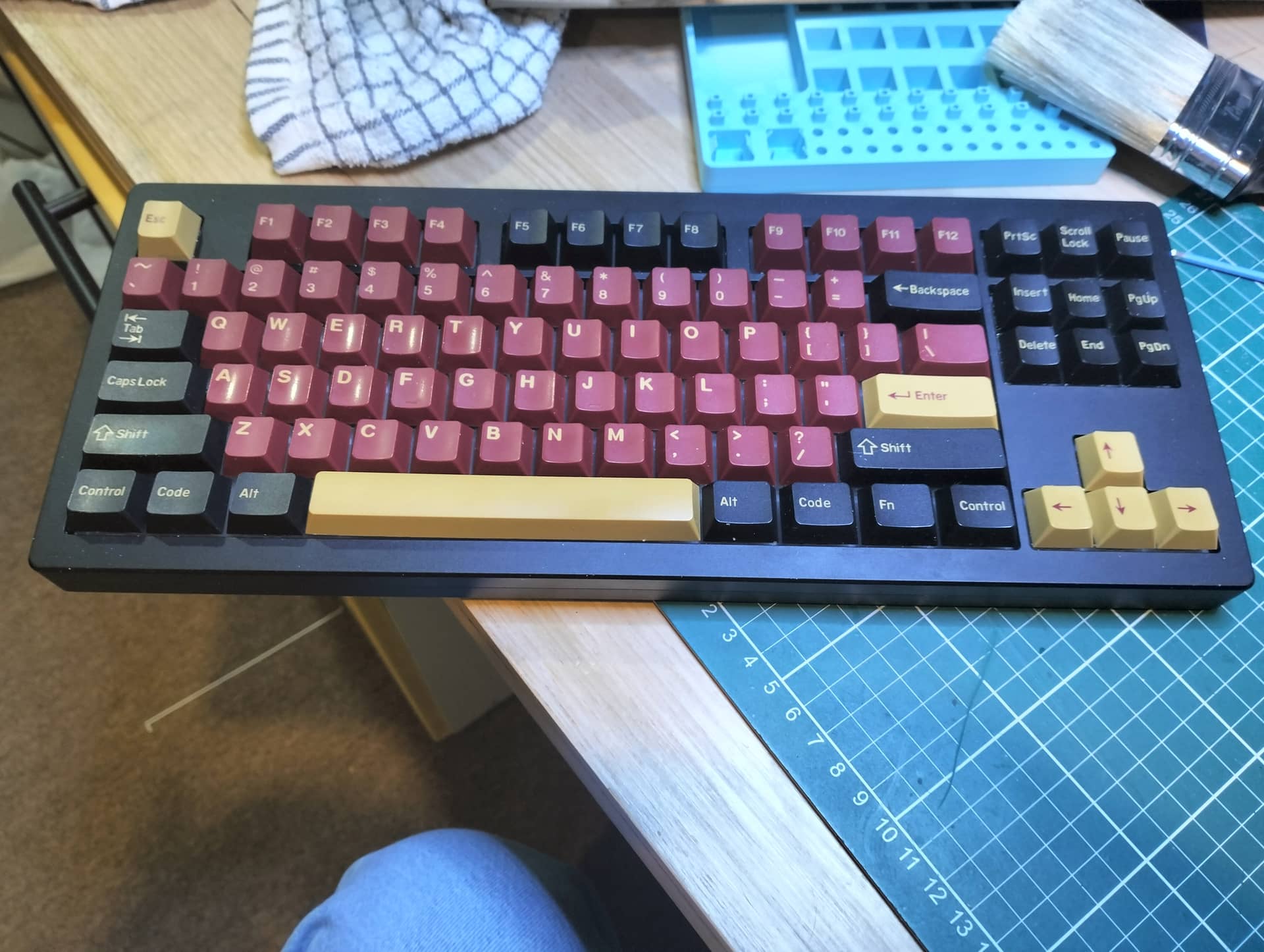
Tested, good as new.
Noticed a few keys are getting shiny so might look around for a new
keycap set
4 Likes
No pictures, since I’m annoyed with myself, but the reduced vertical space that came from my dummy PCB meant closer quarters for the hand-wiring, and an old nemesis has reared its ugly head: melted insulation where the columns rest against the rows. There are too many non-working keys to diagnose by eye, so I’ll be somewhat tediously picking apart each junction to reinsulate it with a fold of kapton tape. With any luck that will do the trick, and I’ll be evaluating some material and technique choices for future hand-wire projects. 
2 Likes
Ahhhh that’s gotta be the worst when it comes to handwiring lol, slightly melted through insulation.
1 Like
Yeah, I mostly use the solid strands from cat-6 ethernet cable, but I think the color-coded insulation just isn’t meant to withstand much heat. Being self-taught on soldering, I also wouldn’t be surprised at all if the iron is too hot, or I’m holding it too long, or something else.
The upside of having too many keyboards already is that I can take my time and only mess around with this one when I’m feeling the urge. From the little testing I’ve done, I do think my lubed and spring-swapped switches will be a little better than expected.
Transition Lite TKL
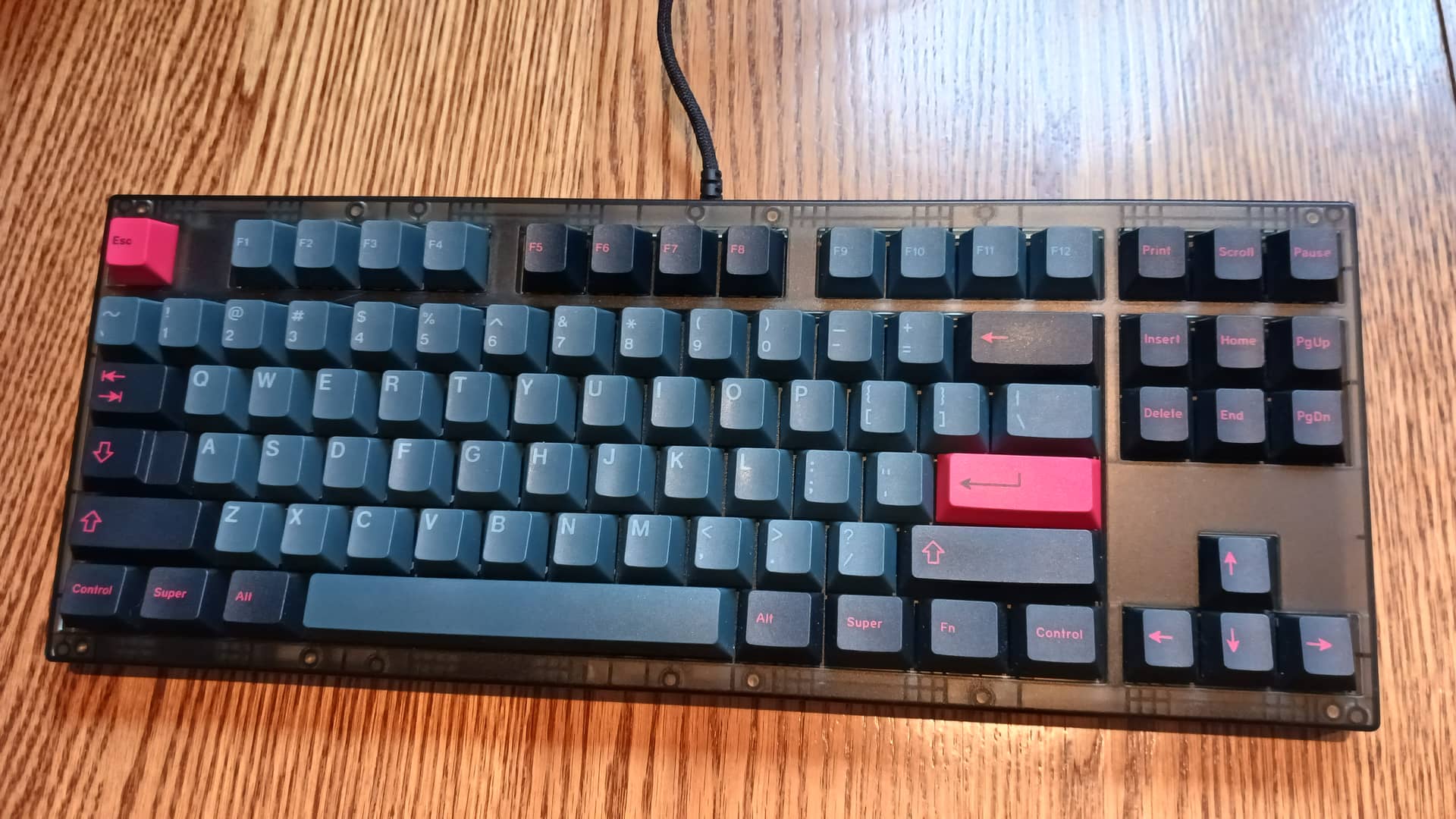
Characteristics:
1.2mm hot-swap PCB, 6.25u space-bar, stepped Caps-Lock
Transparent black case, aftermarket black PP plate
Plate foam and rear PCB foam only
TX 1.2mm stabilizers
Sound Test:
MX Petals, stock.
Modifications:
I am preparing to remove these switches, and so prepared a sound test, and a review of the Cherry MX Petal.
Impressions of Cherry MX Petal:
This is the reason for the post.
I have spent a month typing on stock Cherry MX Petal.
To read impressions, expand the tab below.
Summary
Cherry MX Petal:
I’m about to put away a Cherry MX Petal keyboard for a while.
At least, until I can get to it later. I have typed on it for a month. I think I’m familiar now with the characteristics of this switch.
It’s very interesting, because it’s a Cherry light-tactile, but it’s not an MX Brown.
It’s definitely not an MX Brown.
SUMMARY
Velvety-scratch light-medium tactile with significant diversion from linear prior to actuation. Spring and stem-type encourage bottom-out after actuation. Encourages sharper, snappier typing with significant collision effects.
TACTILITY
It’s sharper, stiffer, and slammier than an MX Brown. To be specific:
The stem is not that of an MX Brown/Clear. The tactile-event is encountered sooner than Brown. It is wider or longer. In fact, the tactile event is more abrupt. Once you encounter the diversion from linear-travel, it forks away more rapidly. And there is less linear pre and post-travel.
So once the tactile event begins, you are on a ride to near-bottom of the stem. And the stem-pole impacts the bottom-housing more abruptly than MX Brown/Clear.
You are more likely to bottom-out. As other reviews mention, the housing collisions seem to provide greater tactility, or at least sound, than the tactile event itself.
Imagine a kind of squarish or rectangular light/medium ‘bump.’ It starts after mild pre-travel [0.5mm? Less?]. The force required to get beyond it encourages you just past the actuation-point. In rapid-typing, this means almost bottoming-out.
It reminds me of a Zealio V2, in the sense that there is a [larger] bump that is such a divergence from linear that you are almost guaranteed to bottom-out. With Zealio V2, the problem was slightly worse, in that you could depress the stem to what felt like an actuation-point, without actuating the switch! This is less likely with the MX Petal stem.
SOUND
The sound itself is notable.
The ‘Cherry scratch’ is present. These are still largely Cherry housings, in intent.
So what you end up with is a kind of “velvety snick.” With a full-travel keypress, and GMK keycaps, you will hear the full operation, including the beginning of the tactile-event, pole-bottoming, and stem return. Because of the ‘Cherry scratch,’ you will hear a velvety scratch, along with the ‘snick’ of the stem.
So, in combination with a PP plate, which should mute things, it’s an interesting sound.
COMPARISON
-
This does not compare directly with an MX Brown. With the sharper tactility, longer spring, and pole-impact, this is almost a clicky-switch.
-
The switch this keeps evoking for me is the AKKO Creamy Purple Pro. Whereas the AKKO tactile seeks a ‘lubed’ sound, this one is ‘drier’ and scratchier.
-
In some ways, it also reminds me of a BOX Brown. In the sense that there is a rapid ‘drop’ into tactility, followed by a cobblestone ‘slam.’ But the MX Petal achieves this in a very different way, relying more on the stem-bottom. That’s why I liken it to the AKKO switch more.
MODIFICATIONS
-I intend to try these switches with 3203 and 3204. I don’t think they need a lot of aftermarket lubrication - they function just fine. Some people may wish to tame the scratch, and that’s fine.
-I also think that springs may be key to this switch. We know that Cherry doesn’t always use the best springs. And I wonder if the long springs, light as they are, are contributing to the switch’s abruptness. I intend to try this out with some 57.5 G 14mm Geon springs, and maybe 50 G 18mm.
So if I get the chance to do that, I’ll post an update. Overall, I think these are a competent effort from Cherry. But people looking for an ‘evolution’ of MX Brown aren’t going to find it here. These are a different force-curve entirely, and do not represent an extension of MX Brown concepts.
8 Likes
Looks like my keyboard refurbish (above) was not without problems
ESC doesn’t work and now BACKSPACE has quit
Switches replaced but not fixed
Leaf springs in hotswap sockets too open? Did you try slightly bending the switch legs for better contact?
4 Likes
Did all that. Even tried a jumper wire acorss the socket contacts directly on the PCB which shows a more serious issue. Need to check every key and make sure it sends what it should
Have a list of keys that don’t work so need to check with QMK to see what’s common, perhaps single IO pin is pulled low/high (hope it’s not the CPU!)
1 Like
Great write up! Thank you for this.
Based on your findings, do you think a fair comparison is that this switch is like a Cherry Brown and a Clear had a baby? Sounds this switch would be a new pillar that would sit between the two: Brown > Petal > Clear. Users could then go up or down the ladder of tactility based on their preference.
2 Likes
Had to deal with my cat having cancer. Do not recommend. (She’s still with us, thankfully, just minus the leg that had the cancer.)
I actually have finished two 40%'s I need to get decent pictures for. I might have gotten a little obsessed with LAE’s and wanted some boards that used them.
Right now, though, I’m seeking my white whale (or endgame, depending on how you look it) in that I’m designing an open-source, hot-swap ISO TKL PCB (h87 size compatible). First revision looks like I got the size right but made some mistakes on the silkscreen (of course). Debating on whether to build as-is or wait for a v2 PCB to come back.
One thing I’m noticing is that I need to switch micros to the ST ones everyone’s using – the RP2040 is dirt cheap, but it requires an external memory chip which is NOT and also increasingly hard to find in the easier-to-hand-solder SOIC package. So now I need to figure out how to use the STM32F072 for a keeb – not rocket surgery, but I still have to figure out a lot of details that are annoying (crystal/caps, reset/DFU mode circuitry).
Oh, and also trying my hand at a 4 button EC macropad, which has been an…interesting challenge. I even got the hardware together and mechanically working, but the firmware is being trickier. I’m using cipulot’s code as reference, of course, which is a huge help, but having to slice out the analog mux code is a bit interesting in the small amount of time I’ve been able to give it.
3 Likes
Sorry to hear about your cat. I had a 3-legged cat growing up named Alex. He was pretty cool.
You know what. I appreciate the sentiment - drawing a clear progression along the MX ‘tactiles.’ Yet, I don’t think that it’s a clear incline.
Brown and Clear are definitely related. Clear is the ‘older’ sibling. It’s basically an MX Brown, but larger.
But MX Petal is something different. It’s more of a ‘cousin’ to Brown and Clear.
For details, please expand the Summary.
Summary
Both in terms of switch-feel, and looking at the stems in particular, Petal is not a classic-style MX tactile.
Brown and Clear are both linear-travel with a ‘bump.’ With MX Brown, the bump begins near the middle. With Ergo Clears, the bump may seem to begin a bit earlier. But in each case, the tactile event is preceded and followed-by linear-travel.
MX Brown and Clear are known for: linear travel, round bump, soft housing-collisions.
MX Petal, by contrast, is much snappier. It’s almost like a Huano Banana in comparison, if you remember those. The Petal is a combination of two switches, but not Brown and Clear.
It’s actually a combination of MX Brown and Zealio V2. It has a Cherry-like housing, and light-tactile spring. But it has a bump shape more reminiscent [to me] of Zealio V2. It’s scaled-down from Zeal, to be sure. The tactile event is larger and more clearly-defined in the keypress than MX Brown or Clear.
You can almost ‘hang’ the tactile bump before the actuation point, as in Zealio V2. But MX Petal largely avoids this.
So I would say it’s a cross between MX Brown and Zealio V2. Or, given that the Petal seems to have a stem that contacts the bottom-housing, maybe MX Brown and Holy Panda [or MMD Princess.] Plus, the MX Petal uses a long, low-weight spring [unlike Browns or Clears.]
So it’s a mix of large-bump tactiles [scaled-down], Cherry housings, and ‘modern’ features such as long-springs and maybe contact-poles.
It’s therefore more of a ‘sidegrade’ to MX Brown, or a ‘Brown-adjacent’ switch, than an intermediary between MX Brown and Clear. [An intermediary between Brown and Clear might be more like AEBoards MX Naevies 1.5, OUTEMU Ice Purples, or maybe the original OUTEMU Sky, before revisions.]
If MX Brown and Clear are different sized bicycles, MX Petal might be a Brown-sized tricycle.
Interestingly, they all use very different springs in stock form. MX Brown uses a standard Cherry ‘light’ 60 g ~13.9mm spring, I think. MX Clears used some kind of heavy, maybe progressive or reverse-progressive spring, I forget the term for it. And MX Petal uses a light-weight but long spring, like so many Chinese switches today.
MX Clear becomes much closer to MX Brown when using conventional 14mm springs. I haven’t tested this with MX Petal, but I plan to soon.
[And, as I mentioned, the switch that Petal reminds me the most of is the AKKO Creamy Purple Pro. That switch is also light, with fairly large tactility, and slams quite resonantly using a long-pole. They’re both very crisp, even if sound and lube patterns are different. I don’t know if it’s long-pole or just housing collisions, but Petal gives a similar effect.
Petal and AKKO Creamy Purple Pro encourage staccato, deliberate typing, whereas MX Brown and light Ergo Clears encourage stochastic typing.]
2 Likes
Nothing too exciting, but a fun little project:
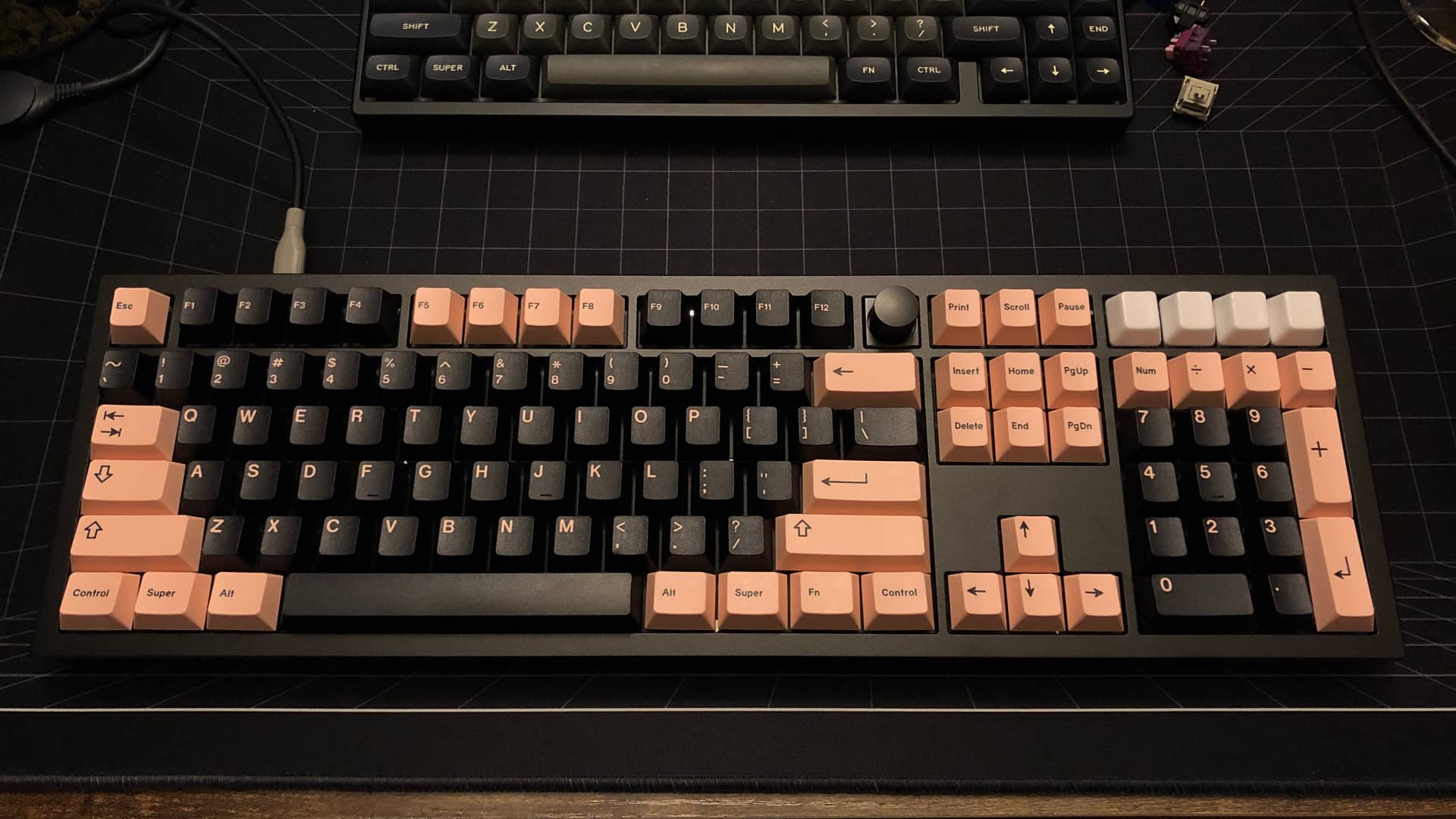
Keychron Q6 Ultra customized for my sister and her office job
- CYL Trüffelschwein (her favorite colors)
- Cerakey blanks on the extra 4 keys
- TTC Silent Bluish Whites (for coworker sanity)
I also remapped lighting controls to the ceramic keys, Number Lock to calculator shortcut, and numpad numbers to row numbers instead for two reasons; she doesn’t use numpad nav, and doesn’t want the numlock key illuminated on its own to use the numbers.
A long-time-coming thank-you gift that I was glad to finally deliver. 
Fun aside - every single member of my family for whom I’ve built a custom board has chosen the same favorite switch. (4 so far, including myself)
7 Likes
All prefer TTC Silent Bluish white? I have some in my Gemini board. Maybe I need to get it out and try them some more
2 Likes
TTC Silent Bluish-Whites [1] are one of my favorite silent tactiles, even with all the innovation of late there. As an OEM silent tactile these days, though, it’s definitely very mid: stem wobble like a bobble-head and lack of stabilizing plastic pins are the major deficiencies. But it has a very unique feel: a wide, heavy bump, with Goldilocks-zone levels of dampening.
The wobble seems entirely down to TTC not updating the molds for the tops/bottoms (of any of their silent tactiles). This is likely due to the need for the extra silicone molding in the bottom housing – the stem design only has silicone contact for the top housing collision, while the bottom of the stem is just a normal pole. So to fix the wobble they’d likely need entirely new molds and a new process. TTC seems too busy chasing the Hall effect market. 
Meanwhile, HMX has announced they can do dual-material molding for all of the plastic components, which should be VERY interesting when applied to silent tactiles.
And Gateron has just dropped some surprisingly not bad[2] silent tactiles recently, starting with the Grape Smoothie and now a few other purple variations, including an “Oil King” variant.
3 Likes
I think that people coming from office rubber-domes are more likely to find silent-tactiles to be familiar.
TTC Silent Bluish White is like a crisp rubber-dome. And there are slightly gentler, mushier ones in the form of the OUTEMU silent-tactiles. [These people might enjoy U4 Boba as well.]
When you put stock silent-tactiles on a factory hotswap board, and custom keycaps, you are kind of creating an office rubber-dome with customized keycaps.
I wonder how these silent tactile hotswap boards compare to the old Foam & Foil that were prevalent in the 1980s/1990s.
3 Likes
So here’s what’s not on my workbench today. My “Battleship at home” hand-wire was acting up a while back, in a way that made me think it has a cold joint in one of the columns. I was all set to crack it open and maybe even trade out the yellow top-plate for a black one that’s hiding beneath it, but when I went to test the keys to remind myself which column was bad, everything worked fine. Go figure. I assume it will show back up again eventually, but I don’t think I’m going to mess with it until the problem resurfaces. This board was my only work board for several months and also spent a few hours getting manhandled at a meetup, so with its being a hand-wire, I’m fairly relieved it’s only ever had the one flutter.
3 Likes
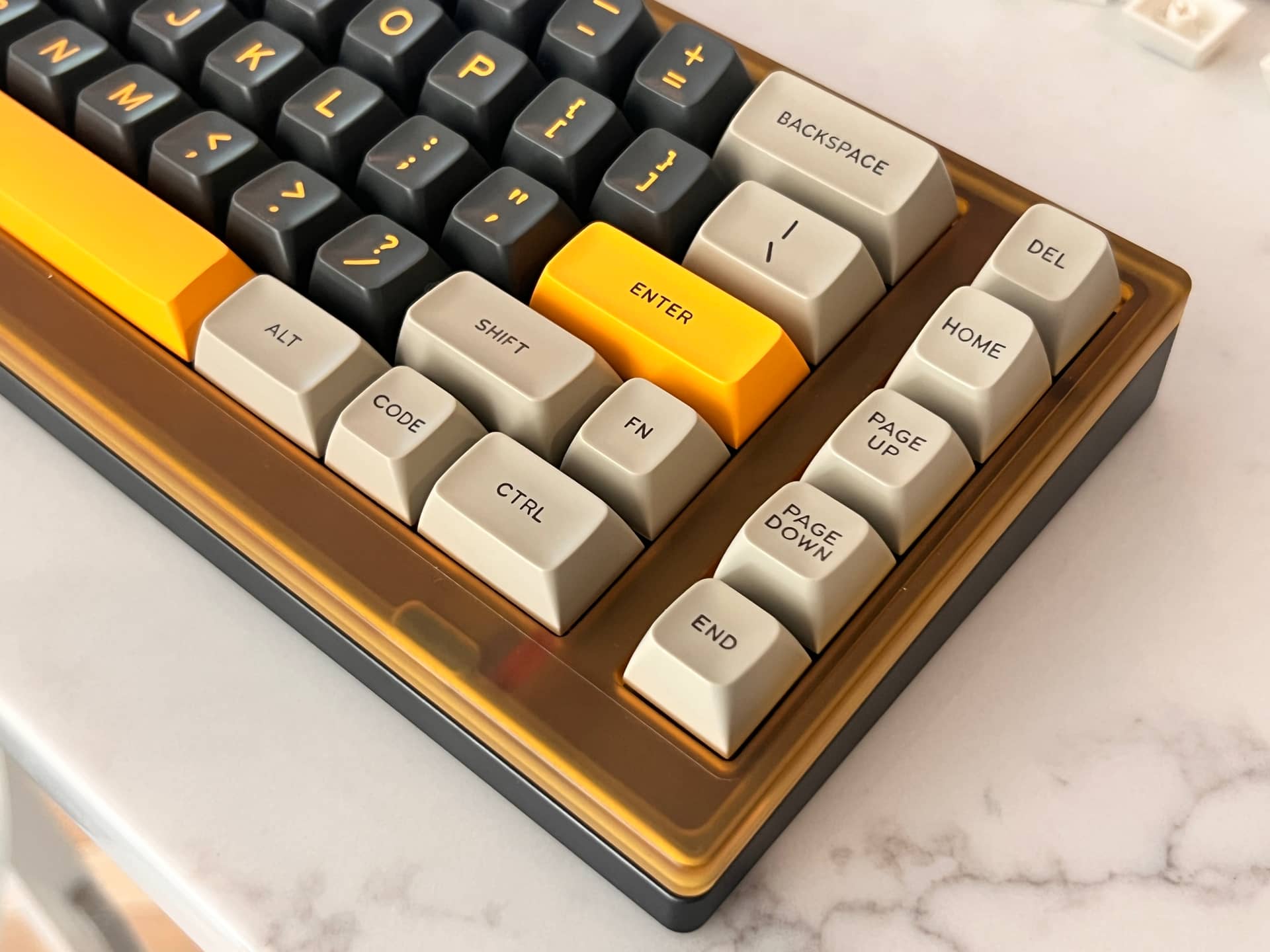
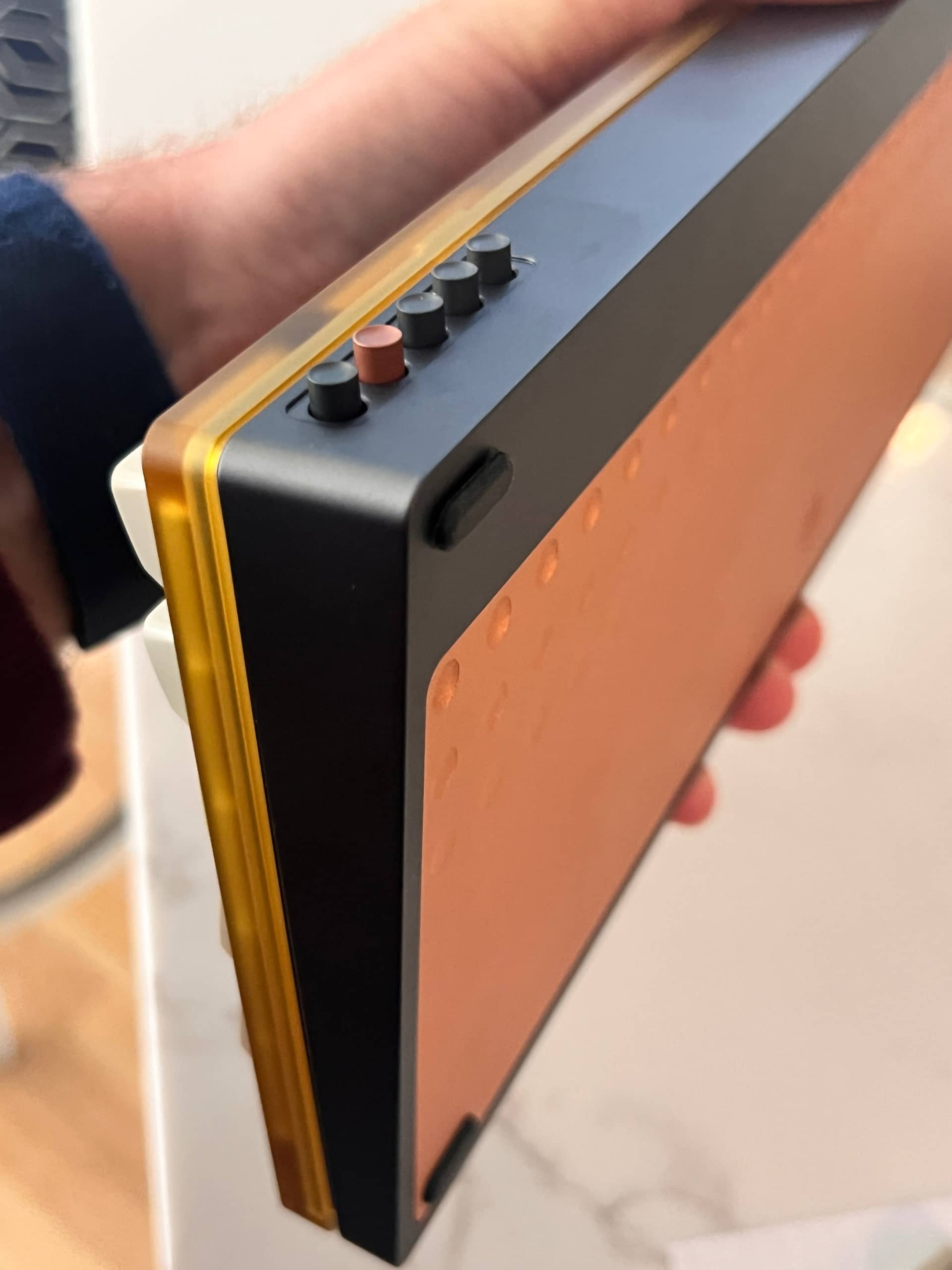
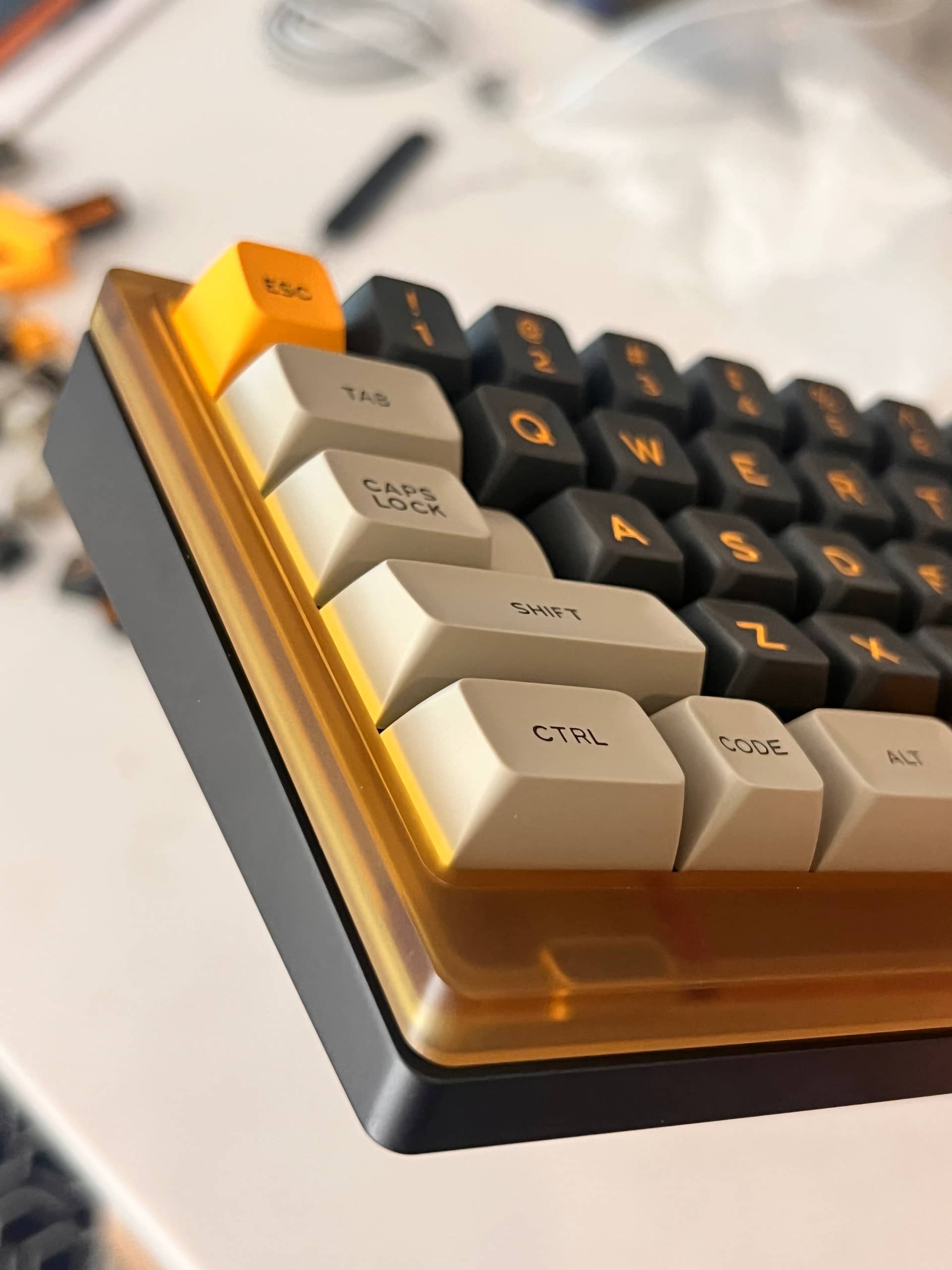
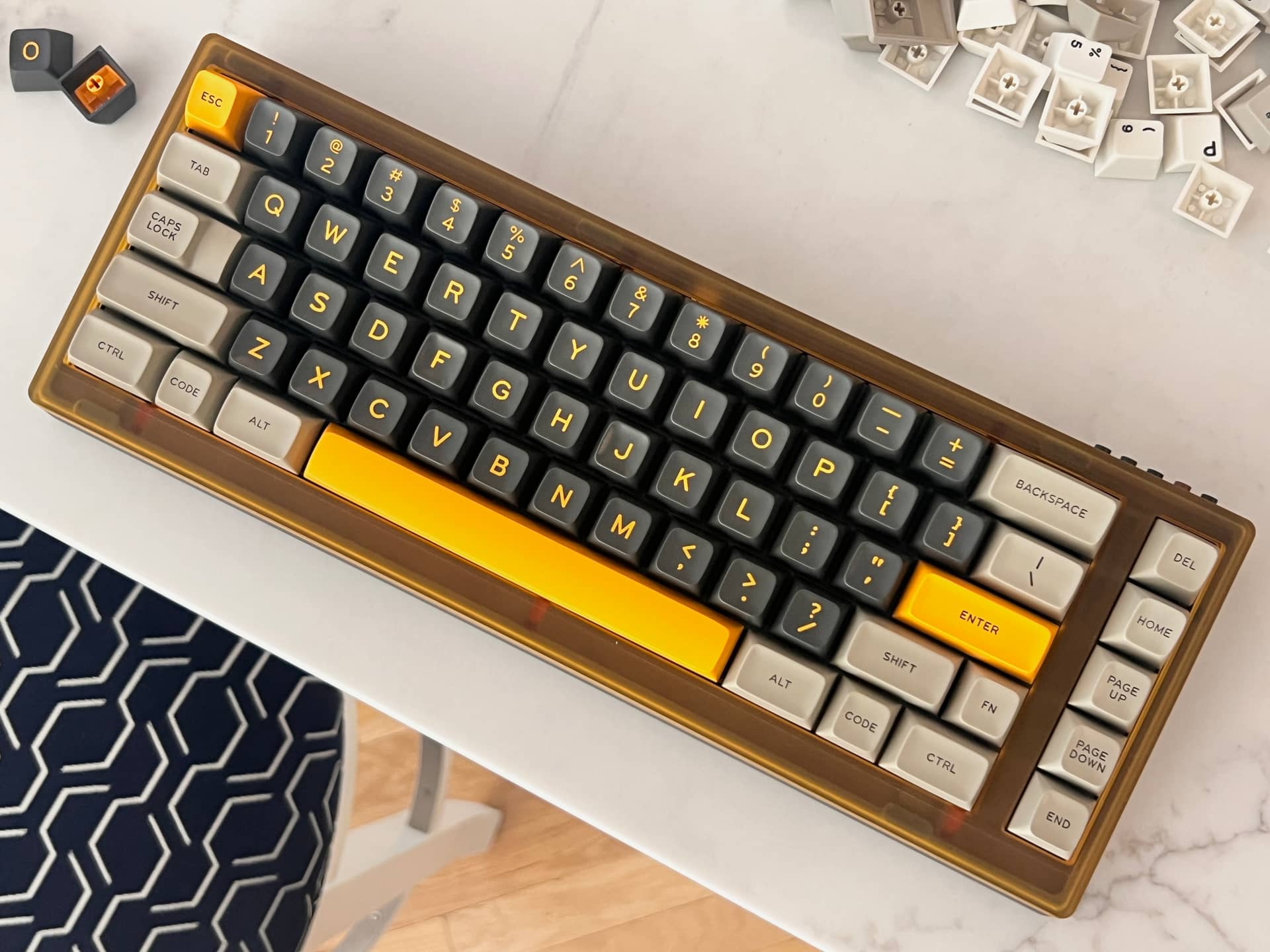
Built my Minerva LX heritage board this weekend
Current using BSUN green arrow switches. Very nice, no fuss linears with a well-rounded sound. I might prefer a slightly heavier spring at the top of press (or longer spring), but they are good switches. 
I thought these budget ASF keycaps looked like a good combo with this colorway.
7 Likes